RC22 - Political Communication

To content | To menu | To search

Events

Entries feed

22Apr

Digital Public Sphere, Political Communication, and Algorithmic Democracy - May 21, 2026

This year, the RC22 conference will happen in Szeged, Hungary. The organizers are:

International Political Science Association RC10 – Electronic Democracy

International Political Science Association RC22 – Political Communication

Legal, Political Aspects of the Digital Public Sphere Research Group of the Centre of Excellence for Interdisciplinary Research, Development and Innovation of the University of Szeged

Department of Political Science, Faculty of Law and Political Sciences, University of Szeged


The conference brings together scholars working at the intersection of digital democracy, political communication, and the transformation of the public sphere under platformized and data-driven conditions. The program explores how political meaning is produced, circulated, contested, and institutionalized in contemporary digital environments, with particular attention to algorithmic mediation, artificial intelligence, short-form video platforms, media visibility, and the changing logics of political leadership and participation. Across different national and comparative perspectives, the papers address a broad range of interconnected questions, including how digital publics are shaped by identity formation and conflict, how AI increasingly influences democratic resilience and political agency, how machine learning can be used as a methodological tool in political communication research, how short-form video reconfigures attention and political subjectivity, how electoral campaigns unfold in hybrid and platform-dependent media environments, and how democracies respond to hybrid threats and new communicative vulnerabilities. By combining conceptual, methodological, and empirical contributions, the conference aims to deepen our understanding of the digital public sphere as a dynamic arena in which political actors, citizens, technologies, and institutions continuously negotiate legitimacy, visibility, and power.

For more information, see the attached program.
12Nov

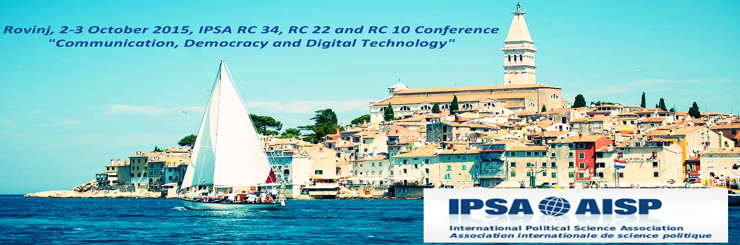
CALL FOR PAPERS: "Communication, Democracy and Digital Technology", Rovinj, Croatia, 2 - 3 October 2015

The conference is organised by a committee formed from IPSA RC10 (Electronic Democracy), RC22 (Political Communication) and RC34 (Quality of Democracy). The conference is going to take place in cooperation with the Faculty of Political Science, University of Zagreb.

The conference theme focuses on the intersection between the work of three strands of political science, all of which ask questions of vital importance for the well-being of democracy globally. These questions revolve around measures, standards and analyses of the quality of democracy, the role of political communication in enhancing democracy and the extent that information and communication technology offers potential for a richer, interactive and co-created politics. Without imposing any normative ontologies onto the discussion we enquire how communicative acts, particularly but not exclusively those which take place using digital technologies, contribute positively or negatively to the quality of the democratic experience for citizens and to sustaining active democracies.

We therefore invite papers which contribute theoretically and empirically to this and relevant debates. Papers should have the concept of democracy (political participation, engagement and deliberation) at their heart and make explicit links to the contribution from theory and practice of digital political communication either by governments, political parties or candidates, media organisations, citizens, non-governmental actors or social movements. Papers focusing on cross-national comparative analyses are particularly welcome.

Selection will be based on the submission of abstracts which should contain the following information:

• Title

• Author and Affiliation

• Core theoretical premise of the paper

• Methodology and relevant information on data collection and analysis

• Key findings or questions that analysis will address if ongoing research

Abstracts should not be longer than 500 words.

Abstracts should be emailed to ipsa2015@fpzg.hr and must be received by 20 January 2015. Notifications of acceptance will be sent by 1 March 2015.

Event fees

Conference fees include participation, conference packs, coffee breaks and welcome event.

Standard fee €120.00

Student fee €80.00

Please note that all participants wishing to attend need to pay a conference fee.

Key dates and deadlines

20 January 2015 Submission deadline

1 March 2015 Notification of acceptance

1 June 2015 Booking and registration deadline

1 September 2015 Full paper submission

Contact

Organising committee: ipsa2015@fpzg.hr

Local organiser: grbesa@fpzg.hr

About the venue

Hotel Lone is a unique design hotel in Croatia. Featuring an impeccable blend of luxury, beauty, style and cultural heritage, the five star boutique hotel is a perfect leisure and business destination. For more information check http://www.lonehotel.com/en/

Accommodation

Preferential rates have been negotiated in hotels Lone and Eden for the participants of the Conference. Hotels are located next to each other and are within a 10 minutes walk from the beautiful city centre. For more information about hotels check http://www.lonehotel.com/en/ and http://www.maistra.com/Eden_Rovinj.

For exquisite preferential rates and additional early birds discount please keep checking our conference website

Travel

Rovinj is only 30 minutes away from Pula airport which is very well connected with several European airports. Rovinj can also be easily reached via Trieste, Zagreb and Ljubljana. Special conference shuttles will be organised at all times from all these airports to Rovinj and from Rovinj to these airports.

27Jan

CFP: "Parties, People and Elections: Political Communication since 1900". On 14th June 2012, at People’s History Museum, Manchester, UK

The way politicians talk to the people, and how they do so has undergone a dramatic change since 1900. The demise of the mass platform, the birth of radio, cinema and television, and the advent of new social media, has radically reshaped how parties and people interact. Furthermore, increased centralisation, ‘professionalisation’ and the use of experts schooled in the techniques of advertising have all affected what parties say and how they say it...

Continue reading

03Mar

CFP: Conference of the IPSA & IAMCR Political Communication Sections, Nov 17-18 2011

We are pleased to announce the upcoming joint conference of the Research Committee for Political Communication (RC22) of the International Political Science Association (IPSA) being organised in conjunction with the Political Communication Section of the International Association of Media and Communication Research (IAMCR). The conference will take place in Lisbon, Portugal, on November 17-18, 2011.

Continue reading

02Feb

Call for papers - “Net Campaigning in the Global Context: Appropriation, Invention, Transformation”

Workshop supported by the IPSA RC10 - Organized by the Faculty of Political Science, Zagreb, in partnership with DEL research network, Dubrovnik, Croatia, 30 - 31 May 2011

Deadline - 15 March 2011

Continue reading

09Nov

Call for papers - the ECPR General Conference, Reykavik 2011; Political Communication Section

The European Consortium for Political Research is hosting its 6th general conference at University of Iceland, on 25-27 August 2011.

The Political Communication section will host eight panels - further information is available here.

For information on submitting paper proposals please refer to the ECPR advice here. Panel chairs are also available for questions.

23Sep

Call for Papers - "Communicating War in the Media and Arts", 28 January 2011, University of Liverpool

Call for Papers - "Communicating War in the Media and Arts", 28 January 2011 - Organised by the Media and Politics Research group, Department of Communication & Media, University of Liverpool

Continue reading